Inside the Autel AT100 superchip
Sniffing an Autel programmer reading an AT100 blank and setting it into every mode the Autel's menu offers, decoding the stock-HITAG2 management protocol, the shared device key, the memory layout and the page-0xFE type register.
Below is a trace of an Autel programmer identifying an AT100 chip. Blue boxes are what the programmer sends, orange boxes are what the chip answers. Click the graph, then scroll to zoom; drag to pan; the table below lists every message. Zoom in on any box to see the individual bits sitting on the waveform. Encrypted frames show both the ciphertext on the air and the plaintext recovered with the HITAG2 keystream. Use the drop-down to switch between an identify, a detect, and the programmer setting the chip into six of its emulation modes.
Hopefully by the time you have read this post the plot will make sense to you.
Fig. 1 - Sniffed Autel → AT100 sessions. Click a box (or a row in the table) for the decoded meaning. The set traces authenticate, write the type code to page 0xFE, then write that type’s image data into the image pages.
Since it was reversed with Claude’s help there may be errors and mistakes so take this with a pinch of salt. This post is partly for my benefit to document the findings so far and partly to encourage others to look at this and improve our understanding of these chips.
Capturing traces
Recordings of the Autel KM100X configuring the AT100 chip were made using a Proxmark3 and the command lf sniff. The KM100X was balanced precariously on top of the Proxmark3 as shown below.
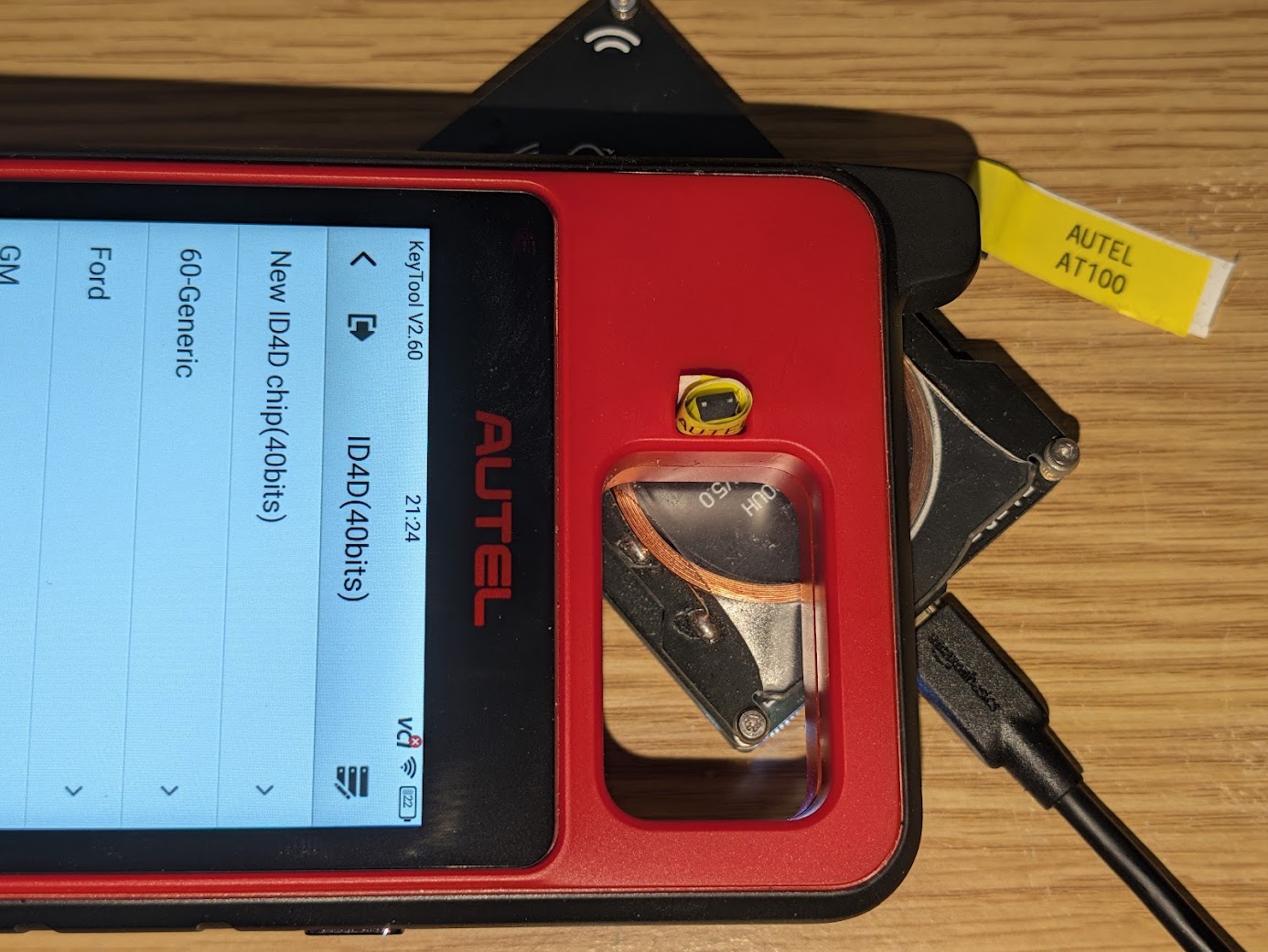 Fig. 2 - The Autel KM100X placed on the Proxmark3 for sniffing communications
When you run lf sniff, the Proxmark3 uses its LF antenna to receive the 125 kHz field generated by the KM100X and records the signal as ADC samples. The resulting trace shows the envelope of the signal rather than the carrier waveform itself.
For reader-to-transponder communication, the reader uses BPLM (Binary Pulse Length Modulation) and the transponder answers by load modulation using Manchester encoding (RF/32). These traces were saved as .pm3 files and Claude was used to write a JavaScript decoding script to make the trace visualiser/decoder that is on this page. The visualiser at the top of the page has the example trace used for all the descriptions in this write up and some traces of configuring the tag to various types, or you can upload your own. This information has been decoded from 29 Autel captures / 85+ sessions; eight of them are in the viewer.
What is the AT100?
The AT100 is a programmable RFID transponder chip, sold for use with Autel key-programming tools. It can be configured to emulate a large number of different transponders such as a HITAG2, EM4102, Megamos, Texas DST and so on. It is the Autel counterpart to the Xhorse XT27A, but where the Xhorse chips use a custom XHORSE/XMICRO communications channel and a bespoke LFSR cipher, the AT100’s management interface is plain HITAG2. The modulation is BPLM from reader to tag, Manchester from tag to reader, and the standard Philips/NXP 48-bit stream cipher that the Proxmark3 already implements in common/hitag2/hitag2_crypto.c.
The tag’s configuration data appears at the end of the “memory space” of the tag. The tag’s UID (not the emulated UID) is sent in response to a custom getUID command (1111100000), and is stored in page 0xFB. The device key used to authenticate in management mode is stored in pages 0xFC (low 32 bits) and 0xFD (high 16 bits). Page 0xFE is the configuration page where the emulated chip type is set.
| Data | Where it lives | Changes when you re-type the chip? |
|---|---|---|
| Emulation page space | 251 pages × 32 bits, addressed 0x00–0xFA | Yes |
Device UID — 32-bit, 0x83xxxxxx, returned in clear before auth | page 0xFB | No |
Device key 9F63A5E8B14B — authenticates the management session; shared by every blank | page 0xFC (low 32 bits) and page 0xFD (high 16 bits) | No |
| Device type | 0xFE is the type register | Yes |
Configuring the chip is done by: authenticate, write the type code to page 0xFE, then write that type’s image into the image pages.
A session, start to finish
The wake handshake (all flows)
Entry is not the standard HITAG2 sequence; the AT100 wakes to a short handshake of its own and returns its device UID (not the emulated tag’s):
1
2
3
4
R>T  1010                   4-bit wake
T>R  1010                   the tag echoes it verbatim
R>T  1111100000             get-UID
T>R  <32-bit UID>           e.g. 0x8358BE8C -- cleartext
The 1111100000 get-UID command looks like it might be a HITAG2 “read page 0” as it uses the same {word}{~word} pattern used by every post-auth command, but it is not: it is the AT100’s own custom command, a 5-bit word 11111 followed by its complement 00000. The UID it returns is the chip’s device serial, not the emulated tag’s. It is not changed by re-typing the chip, but it is not read-only either: writing page 0xFB changes the UID the tag reports.
Authentication (fixed IV)
1
2
R>T  {nR}{aR}  = 64 bits    nR = 0xED355308 (cleartext IV), aR = keystream(32) ^ 0xFFFFFFFF
T>R  <32-bit>               encrypted -- the current page-0xFE type word
The reader IV nR = 0xED355308 has been identical in all of the 85+ captured sessions, on every AT100 tested so far. Because the nonce is fixed, aR depends only on key and UID, and one capture per tag is enough to recover the key.
The AT100’s management interface is stock HITAG2, so the Autel programmer’s own {nR}{aR} auth frame gives you everything a key-recovery attack needs.
ht2crack5 wants two {nR},{aR} pairs for the same UID, and the Autel programmer replays one fixed nonce (0xED355308) in every session, so a tag only ever hands you one pair. Running the attack on that single pair doesn’t yield a key, it yields about 62,000 of them (61,831 from 0x836BC7C7), every one of which reproduces the captured aR perfectly. The stock tool hides this by stopping at the first candidate it reaches, which on my machine was 0x58C0916AE748: a key that authenticates flawlessly against the tag it was cracked from and fails on every other blank. What pins down the real key is redundancy elsewhere in the same capture. Each post-auth command is sent as {W}{~W}, 10 bits of self-check per command, so decrypting a session with 18 commands under all 62,000 candidates leaves exactly one: 0x9F63A5E8B14B. Cross-checking against the other four blanks (the key is shared, and each new UID is another 32-bit constraint) independently leaves the same single key.
It is the same key on every AT100 tested:
1
key = 9F63A5E8B14B
The decoder in Fig. 1 runs this same cipher in your browser, so you can watch each aR verify and each page decrypt as you click through the table. The key’s low half, A5E8B14B, is also readable at page 0xFC; the identify flow reads exactly that one page; it seems to be Autel’s “is this a genuine AT100” check.
The command format
After auth, every frame is encrypted with one continuing keystream, consumed in strict on-air order the same as HITAG2. A command is a 20-bit frame carrying a 10-bit word sent twice, true then complemented ({W}{~W}). The word is op:2 | page:8:
op | Meaning |
|---|---|
01 | READ page — tag replies with the 32-bit page |
10 | WRITE page — tag echoes the 20-bit command, then the reader sends the 32-bit data |
1
2
READ :  R>T {0x1FE}{0x201}            T>R <page 0xFE>
WRITE:  R>T {0x2FE}{0x101}            T>R {0x2FE}{0x101} (echo)   R>T <32-bit data>
The address is a full 8 bits, so the page space is 255 pages × 32 bits (page 0xFF is not accessible). A write is not acknowledged after the data; the Autel just waits ~98 ms for the EEPROM and sends the next command.
Memory map
One 8-bit page address space, split into an emulation region and a device region:
| Pages | Role |
|---|---|
0x00–0x27 | the emulated transponder image; the meaning of each page is type-dependent (below). The biggest image, ID8A’s, reaches page 0x27 |
0x3A–0x3D | extra registers for the Texas ID4D / ID4E family (0x3C selects DST40 vs DST80) |
0x78–0x7B | Set 7937, 7938 and ID4A clear these pages to 0x00000000 |
0x50, 0xC8, 0xF0–0xF4 | extra pages used by MQB49 / ID5C (its serial goes to 0xC8, not 0x00) |
0xFB | AT100 UID (not the emulated tag UID) |
0xFC | device-key low 0xA5E8B14B |
0xFD | device-key high 0x00009F63 |
0xFE | type / configuration register, auto-returned after auth A factory blank holds 0xFE = 0x9B290A9B, so an AT100 ships configured as type ID4D. |
0xFB to 0xFD were confirmed by writing different values to the tag and checking that the UID and auth key changed accordingly.
The type codes
Page 0xFE encodes the emulated type as b3 b2 b1 b0 with b0 = 0x9B and b1 the type index. Sniffing with a Proxmark3 while configuring the AT100 with the Autel tool got the following config page values:
| Autel type | 0xFE word | Autel type | 0xFE word | |
|---|---|---|---|---|
| ID11 / ID12 / ID13 | 9B04019B | 7939 / ID49 | 8F1C079B | |
| 7936 / ID46 | 8F08029B | ID5C / MQB49 | 8F20089B | |
| 7946 | 8F0C039B | ID4C | 9B25099B | |
| 7937 | 8F10049B | ID4D / ID4D-80 | 9B290A9B | |
| 7938 / ID47 | 8F14059B | ID4E | 9B2D0B9B | |
| ID4A | 8F18069B | ID8A | 9B310C9B | |
| ID48 | 8F360D9B | MQB / ID8B | 8F3A0E9B | |
| ID8C | 8F3E0F9B |
ID11/12/13 share one code (the variant is carried in page 0x00), and so do ID4D and its 80-bit variant (distinguished by page 0x3C).
What a “set” actually writes
The set traces are the interesting ones; each is the Autel programming the blank into one emulated identity. A few, selectable in Fig. 1, give the flavour of how different the images are:
- 7936 / ID46 — the factory MIKRON HITAG2 image. Page
0x00is a fresh random serial,0x01/0x02spell the HITAG2 key"MIKR"+"..ON",0x03is the config/password06AA4854. These are the factory defaults for a HITAG2 chip. - ID13 — EM4102. Pages
0x01/0x02are a literal, fully valid 64-bit EM4102 frame: nine header ones, ten rows of four data bits with correct row parity, four correct column-parity bits and a stop bit, carrying ID04 56 B3 07 C8. (Its siblings ID11/ID12 use the same two pages for other fixed-code formats, selected by a mode field in page0x00.) - ID48 — Megamos Crypto. An eight-page Megamos block with
AAAAAAAAlock words at0x06/0x07. MQB / ID8B is built on top of the same block with four extra pages. - ID5C / MQB49. The odd one out — its serial goes to page
0xC8, and it scatters constants across pages0x0C,0x0D,0x11,0x50and0xF0–0xF4. It also writes0x00–0x07(FFFFFFFF×4, then00000000×4). - ID8A — TI DST AES (128-bit). A big 40-page image (
0x00–0x27); only the even pages carry payload. - ID4C writes an 8-byte UID plus a CRC-16/XMODEM in the high half of page
0x02(verified against the captured value).
The programming order is almost always the same: WRITE 0xFE = <type code>, then the image pages. The exceptions are the fixed-code family writes page 0x00 first, 7937/7946 program the chip as ID46 and then re-type it, and MQB49 writes its serial up front. Serial-like values (UID) are generated fresh by the Autel on every run, so those bytes differ from capture to capture; everything else is constant.
Preliminary Proxmark3 support: lf autel
I have made a branch of the Proxmark3 code where I am testing with these tags on my github. I hope to eventually get this into the main Proxmark3 repo but until then if you want to try use that fork. It is experimental, while it has worked for me while testing these tags, I cannot guarantee it wont harm your tag!
The command set is:
| Command | What it does |
|---|---|
lf autel list | the emulated-type catalogue, each type’s 0xFE code and UID rule |
lf autel dump | reads every readable page |
lf autel read -p <page> [-n <count>] | arbitrary pages, 0x00–0xFE |
lf autel write -p <page> -d <hex> | one raw page, with read-back verify |
lf autel configure -t <type> [-u <uid>] | writes 0xFE then the type’s image, in one session |
lf autel reset | restores the factory image and type 9B290A9B (ID4D) |
All of the commands except list take -k for a blank whose device key is not the shared 9F63A5E8B14B. Each of the 18 catalogue types was diffed against the trace it came from.
Still unknown
- The config word’s redundant fields, and the type indices (
0x00,0x10+) and menu entries (7935, ID8E, the MQB Renegade/4.5 variants) not present in these captures.
Viewer: viewer.js · decoder: at100-decoder.js — self-contained, with its own copy of the HITAG2 physical layer and a port of the Proxmark3 HITAG2 cipher, verified bit-exact against the C for every auth in these captures (written by Claude, public domain, help yourself).